Moderation
The operator console (the “Brass Console” companion app) exposes the moderation actions an operator needs. Every action reports what it did, and the console doesn’t soften or hide the effect.
Actions
Section titled “Actions”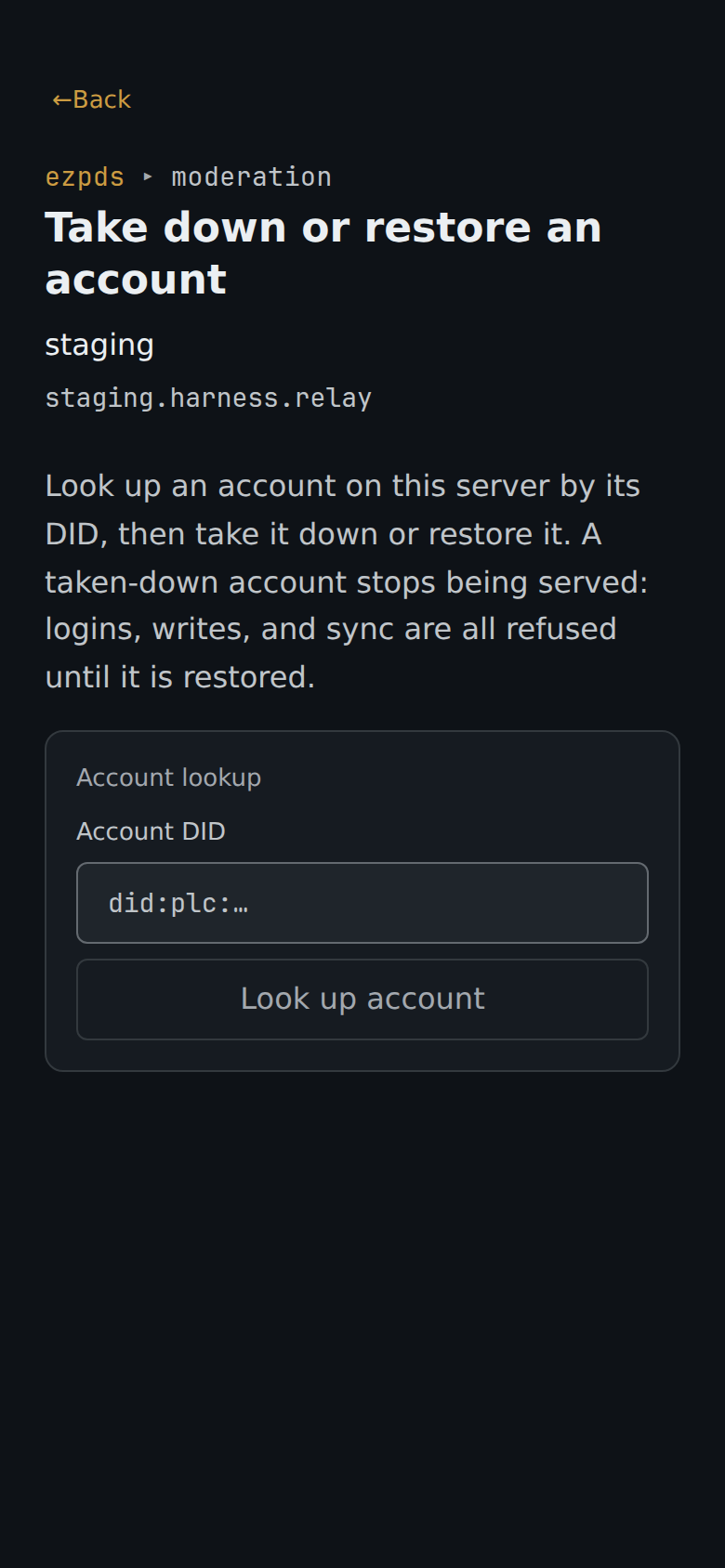
On the Moderation screen (look up an account by DID first):
- Takedown — stop serving an account: logins, writes, and sync are refused until it is restored.
- Restore — reverse a takedown (the account resumes serving unless it is also suspended or deactivated).
- Credential revocation — the incident-response follow-up for a compromised account: in one sweep it revokes the account’s sessions, app passwords, OAuth grants and pending authorization codes, and transfer-device tokens, and reports the literal per-family counts. The account’s main password is untouched, and any already-issued access tokens lapse on their own within minutes. Every holder, including the owner, is signed out and must log in again.
You reach an account by tapping it in the account list, which is searchable by handle or DID and shows each account’s blob quota.
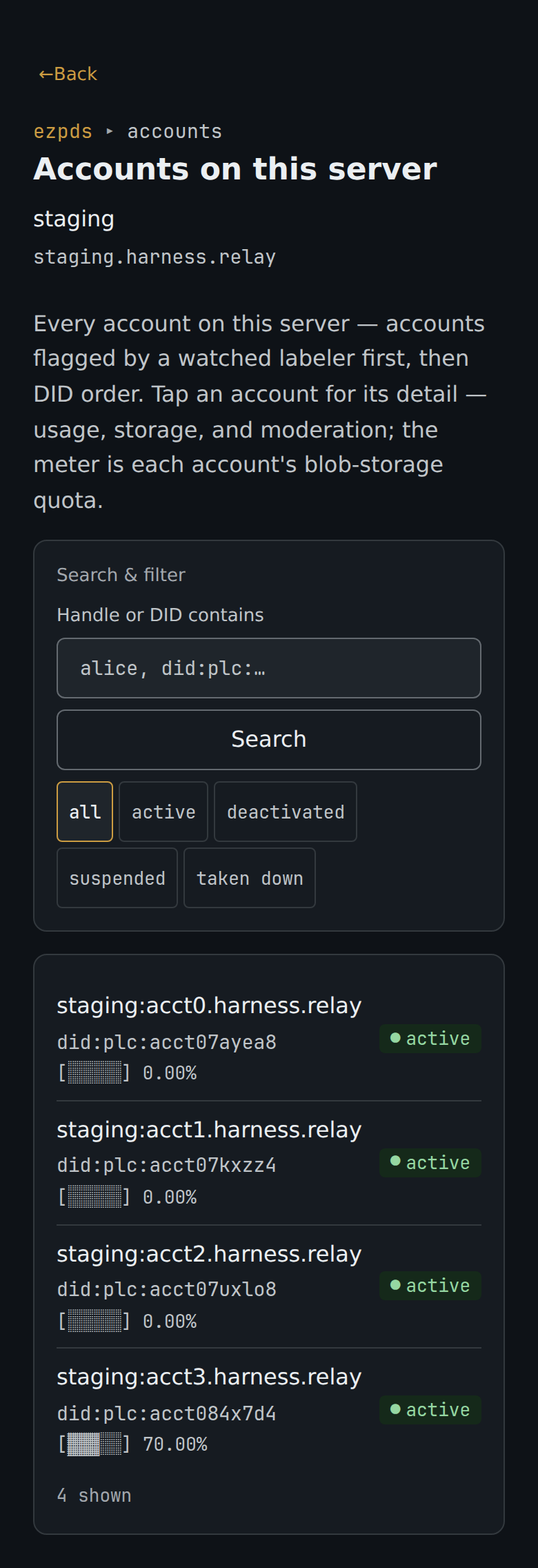
On the Account detail screen (reached by tapping an account in the list):
- Correct an email — fix an account’s email address; this resets it to unconfirmed.
- Issue a password-reset token — mint a single-use, one-hour reset token for out-of-band delivery. This is refused for a passwordless / key-sovereign account: those recover through their escrowed key share, not a reset.
Both takedown and credential revocation are destructive, so the console arms them behind a two-tap confirmation that restates the target, then a biometric gate, before anything is signed.
Labeler watching — flagged accounts
Section titled “Labeler watching — flagged accounts”Custos can watch ATProto labelers (moderation services) and flag any hosted
account they label. Flagged accounts float to the top of the console’s account
list with an explicit ⚑ indicator per label (the label value, the labeler,
and when it was applied), and the Home screen shows a flagged-accounts notice
for the active server. This turns the account list from a neutral roster into a
spam/abuse triage view: if a labeler your network trusts flags one of your
accounts, you see it on your next glance at the console.
Watching is off by default: you choose which labelers’ judgment reorders your console. The recommended starting point is Bluesky’s moderation service:
# Environment form: comma-separated labeler DIDs, each watching every label value.EZPDS_LABELER_WATCHED=did:plc:ar7c4by46qjdydhdevvrndacor, in pds.toml, with an optional per-labeler watchlist (empty or omitted
labels means every label from that labeler counts):
[labeler]poll_interval_secs = 900 # default: 15 minutes
[[labeler.watched]]did = "did:plc:ar7c4by46qjdydhdevvrndac" # Bluesky Moderationlabels = ["spam", "!hide", "!warn"]      # omit to watch every label
[[labeler.watched]]did = "did:web:some-other-labeler.example" # any labeler works, not just Bluesky's
How it works: a background pass polls each watched labeler’s
com.atproto.label.queryLabels for your hosted accounts (the labeler’s query
endpoint is resolved from its DID document), honoring label negations and
expiry, and reconciles the flagged state the console reads. The first pass runs
at startup, then every poll_interval_secs. The health readout reports the
watcher’s last completed pass, so a stale pass is visible on the Status screen.
Two things worth knowing before you enable it:
- Each poll discloses your hosted-account DIDs to the watched labeler (they
arrive as the query’s
uriPatterns). Hosted DIDs are already publicly enumerable viacom.atproto.sync.listRepos, but watching a labeler does establish a recurring outbound relationship with it, which is why it’s an explicit opt-in. - A flag is the labeler’s opinion, not a verdict. Flagging changes only the sort order and the indicator; it takes no action against the account. Takedown and credential revocation remain your gated decisions above.
Removing a labeler from the config (or disabling watching entirely) clears its flags on the next pass or restart; flagged state never outlives the configuration that produced it.
Accountability
Section titled “Accountability”Moderation actions are shown with their subject, the operator device that signed them, and the result, with status carried in text, not by color alone. Pair any externally visible action with a clear, honest explanation to the affected user; the tooling reports the literal truth, and so should you.